

French collaboration led by Ben Wieder, an IPhT researcher, uncovers chiral topological phases in metals without structural order, previously thought to be topologically featureless.
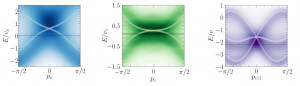
Figure: Amorphous chiral fermions. The spectral functions of 3 different condensed-matter chiral fermions in structurally amorphous models. While all three chiral systems have no exact symmetry, they still exhibit topologically distinct spectra that can be predicted by average symmetry group theory.
Fermions are one of the most important particles in physics, and include both everyday electrons and more exotic variants. Chiral fermions, like gloves, come in left- and right-handed versions, and were proposed over a century ago. While high-energy neutrinos—the leading candidates for massless chiral fermions—proved to have mass, nearly (semi-) metallic solid-state crystals were discovered 15 years ago to host electronic versions of massless chiral fermions.
With their slightly overlapping electronic conduction and valence states, semimetals sit halfway between metals and insulators in terms of conductivity. Topological semimetals (TSMs) are distinguished by electronic properties protected by the geometric structure of their electron wavefunctions, making them resistant to disruption and exciting tabletop venues for quantum electronic responses.
Chiral TSMs come in two variants: with or without lattice structural chirality. In his postdoctoral research [2], Benjamin Wieder (IPhT) showed that lattice structural chirality serves as a tunable mechanism for generating ideal TSM phases. This work opened pathways for exploring industry-relevant applications, including enantioselective photoresponse (light-driven responses depending on the material’s left or right handedness) and topologically enhanced chemical catalysis.
While theory predicted that TSM phases would be destroyed by moderate disorder, requiring highly crystalline samples, recent experiments have shown that many of the advantageous electronic properties of TSM materials persist in amorphous structural phases of the same material.
To resolve this contradiction, Wieder collaborated with Adolfo Grushin’s group at Université Grenoble Alpes. Using symmetry group theory methods from Wieder’s ERC project TopoRosetta, the team discovered that prior studies overlooked that amorphous materials can maintain local chirality order. Their breakthrough: local chirality order and group theory mathematics together enable the design of robust amorphous chiral TSM phases. Published as an Editors’ Suggestion in Physical Review Materials (October 2026), this work [1] challenges the established view that disorder inevitably destroys metallic topological states. The team is now adapting these methods for first-principles material simulations in readily accessible amorphous materials.
[1] Phys. Rev. Materials 10, 104201 (2026), Editors’ Suggestion | arXiv:2512.19791