


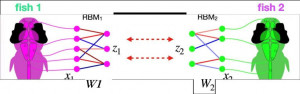
Spontaneous brain activity, without external stimuli, shapes development, constrains coding, and reflects neural organization. Whether this activity reveals similar organization across individuals has been unclear.
Using single-cell, whole-brain recordings in larval zebrafish and statistical learning, we find that spontaneous dynamics share a common structure across animals. Spatially organized coactivated neuron assemblies recur across individuals and act as building blocks of population activity. This shared representation enables fictive translation of activity from one fish into another’s neural space while preserving spatial and statistical plausibility. These results suggest that brains organize population activity by similar principles to represent internal states. Our findings reveal conserved organization in the vertebrate brain and establish a quantitative framework for comparing brain dynamics across individuals and conditions.