


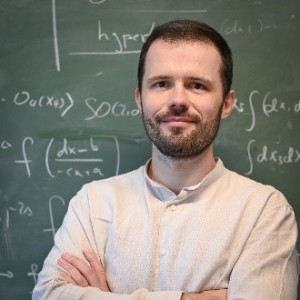
The European Research Council (ERC) has announced the recipients of the 2025 Consolidator Grants. Supporting the best exploratory research across all fields, these grants reward mid-career scientists. Among them, Dalimil Mazac, a researcher at IPhT (CEA-CNRS), has been recognized for his work on the mathematics of quantum field theory.
Dalimil Mazac has been a permanent researcher at IPhT since 2023. He obtained his PhD from the Perimeter Institute for Theoretical Physics, then held postdoctoral positions at Stony Brook and Princeton. His work lies in the field of mathematical physics, at the interface between quantum field theory, harmonic analysis, and number theory.
Quantum field theory (QFT) is a universal predictive framework for describing physics at all scales, from particle physics through statistical physics to cosmology. Despite decades of developments, its mathematical foundations remain only partially understood. Dalimil Mazac’s research efforts aim to better understand the deep nature of QFT, and has already revealed unexpected links with other areas of mathematics. Among these are L-functions, which make it possible to analyze the properties of prime numbers using functions of a complex variable. Previously, Dalimil Mazac also discovered an unexpected and fruitful connection between QFT and the sphere-packing problem, which consists in determining the densest possible arrangement of identical nonoverlapping spheres in various dimensions of space.
His ERC Consolidator project, HARMONICON (Connecting Harmonic Analysis and Conformal Field Theory), aims to deepen and expand these connections. The goal is to develop a rigorous mathematical framework for conformal field theories, which form an important class of QFTs that remain unchanged under changes in length scale, with many applications in particle physics and statistical physics. Physical observables in conformal field theories are characterized by power laws governed by scaling exponents. The HARMONICON project envisions to determine these exponents in systems where this was previously impossible, notably for models of polymer in three dimensions.
Congratulations to Dalimil!